
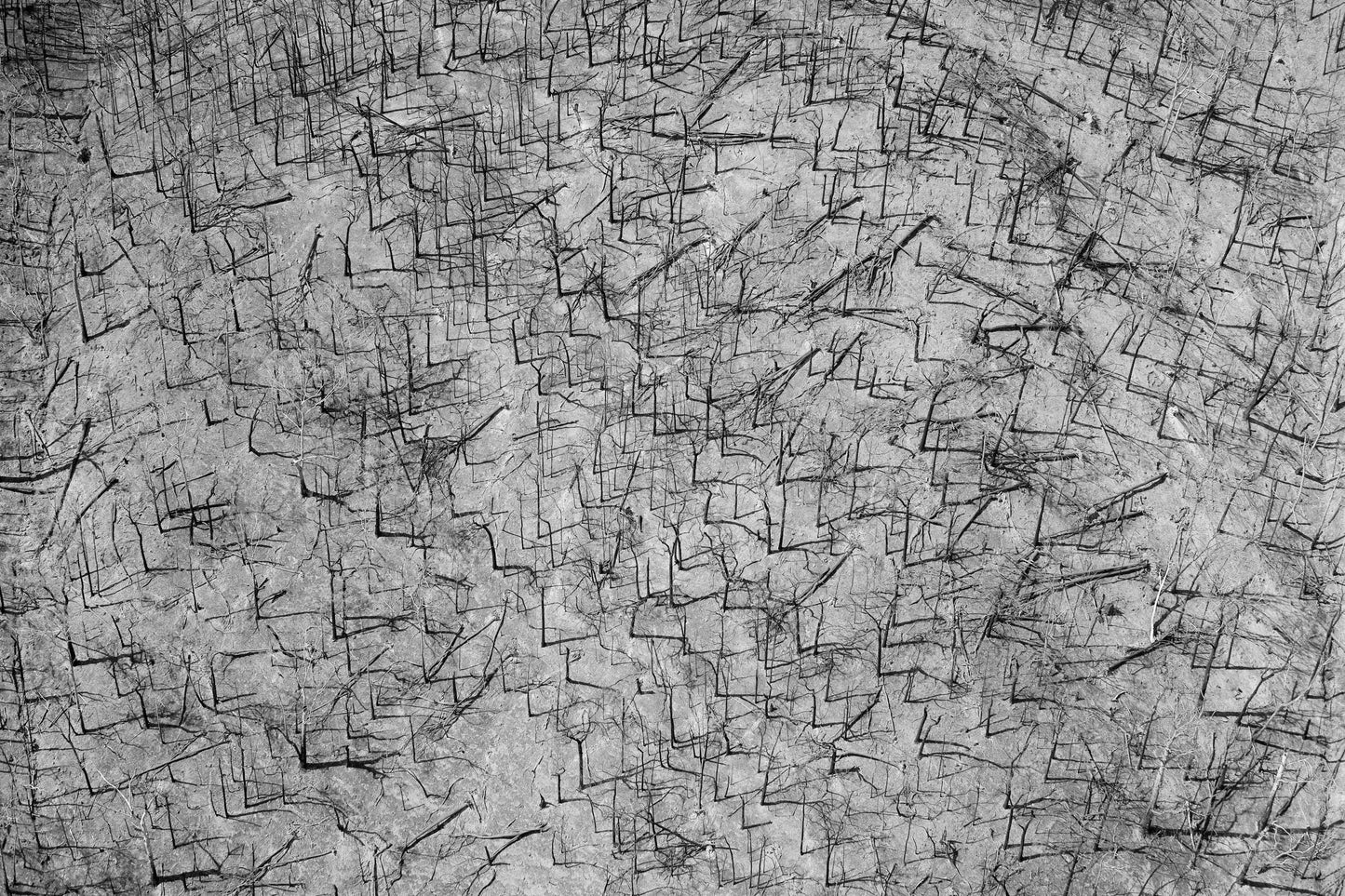
John GOLLINGS: Black Saturday 02, Kinglake
John GOLLINGS: Black Saturday 02, Kinglake
Couldn't load pickup availability
2026 MAPh Photography Fair
John GOLLINGS
born Australia 1944
Black Saturday 02, Kinglake 2009
ink-jet print
unframed, mounted to foam core
51.0 x 76.5 cm
ed. of 10
collection of the artist
courtesy of the artist
John Gollings (1944 - )
John Gollings is Australia’s most pre-eminent and prolific photographer of the built environment. For the past 50 years he has been synthesising his parallel interests in photography and architecture to explore the cultural construction of social spaces. From sacred rock art sites and ancient temples to suburban dream homes and the monuments of corporate architecture, Gollings’s catalogue of images provides a remarkable visual history of human habitats. The history of the built world was the first major survey of Gollings photographic practice and was exhibited at MAPh in 2018 before touring across Australia and to India. It offered a much anticipated opportunity to appreciate the full breadth of his unique photographic vision. Gollings's work is currently the focus of an exhibition at the National Gallery of Victoria John Gollings | Artists Room (28 Feb – 26 Aug 2026).
Gollings made his first photographs and received darkroom tuition at age 11. He later studied architecture at the University of Melbourne and completed a Masters in Architecture at RMIT. He worked as a freelance advertising photographer, specialising in fashion and, as his contemporaries in architecture developed their practices, he increasingly focused on architectural photography for which he is now well-known. He has subsequently lectured on architecture and photography. He has recently spent more time on longer term projects with academic or cultural significance for books, exhibitions and fine prints, including the documentation of dead cities in countries such as India, Cambodia and Libya.
While Gollings is best known for his work as an architectural photographer, he has produced a number of works that hone in on the Australian landscape. This aerial photograph looks down onto a landscape that has been scorched by bushfire. Viewed from above, without any horizon line to give a sense of scale or orientation to the terrain, this charred topography takes on the appearance of hairy, stubbled skin. Gollings uses this ambiguity to great effect, making the dirt tracks look like wounds that have scarred the surface of the earth, and the effects of smoke and ash look like bruises. In this respect, the use of aerial photography has allowed the images to be read as abstract ciphers of ecological trauma.
Would you like to support the future of MAPh?
MAPh
Donation to Support MAPh
Share
